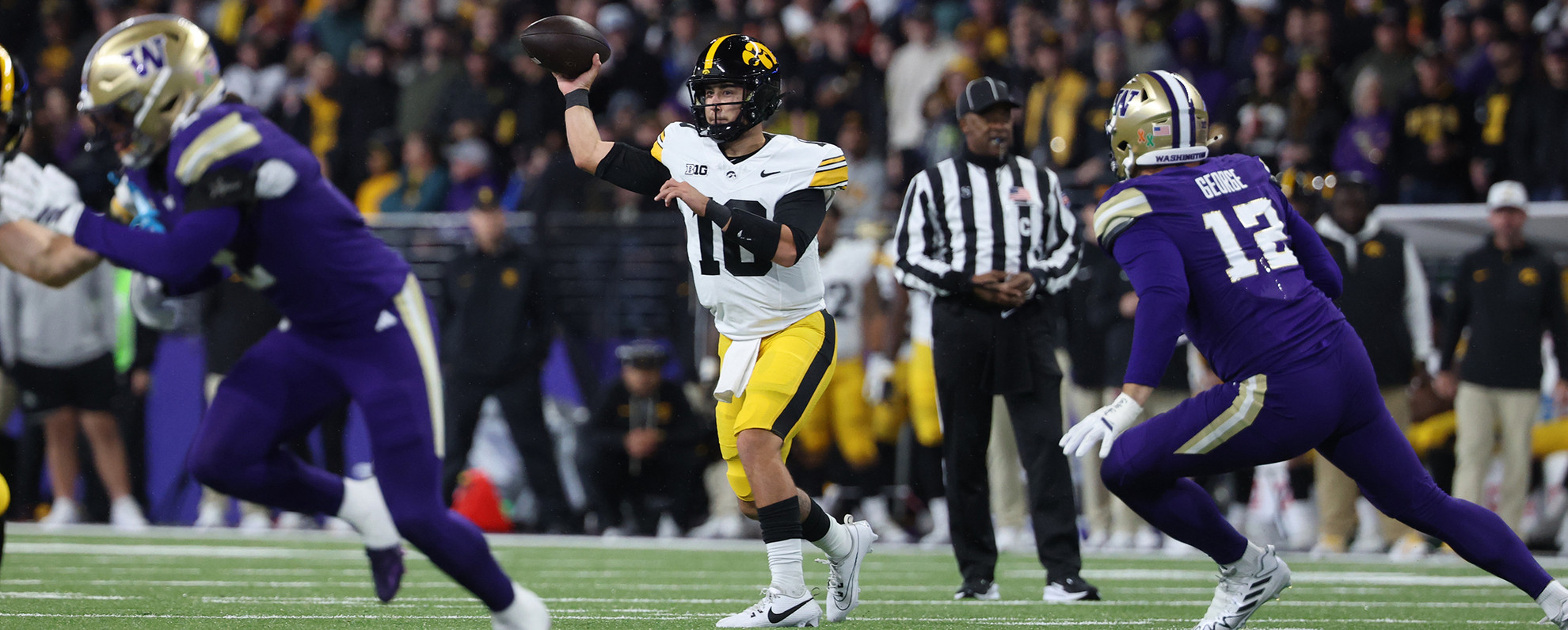
Iowa’s new starter benefited from an offense with two working answers
Jeremy Hecklinski’s debut and Kamari Moulton’s big night made the Hawkeyes harder to defend in Seattle.
Iowa beat Washington 41–24 in Seattle on Friday, October 9. Jeremy Hecklinski made his first career start and threw for 202 yards and three touchdowns. Iowa’s October 12 announcement recognized him as a Manning Award Star of the Week and listed the Hawkeyes at 5–1 before their October 24 trip to Minnesota.
The official game recap credits Kamari Moulton with a career-high 208 rushing yards and two touchdowns on 26 carries. Iowa gained 465 total yards and recorded six sacks. Hecklinski completed 14 of 19 passes. Those numbers describe an offense with productive rushing and passing components, supported by meaningful defensive disruption.
Balance is about conflicting responsibilities
Our view is that the useful feature of Iowa’s performance was not an equal division of run and pass attempts. It was having more than one credible way to punish a defensive choice. A defense devoting extra attention to Moulton risks opening a passing window. A defense widening to account for receivers can give the running game a more favorable blocking problem.
That relationship is especially valuable for a quarterback making a first start. A clear throwing opportunity is easier to use than one that appears only after the play begins to deteriorate. Iowa should review which formations and down-and-distance situations helped Hecklinski identify those opportunities. The aim is to preserve the structure that made his debut efficient, even when the next opponent approaches him with more preparation and different personnel.
Repeat the support, not the career highs
Moulton should not need another 208-yard game to make the offense function. The more sustainable target is a rushing attack that keeps the quarterback from facing obvious passing situations over and over. Similarly, six sacks are a major defensive contribution, but forcing a punt without a sack still produces the next opportunity for the offense.
During the open week, Iowa can examine how its units created that chain of advantages. We would watch whether its next game includes successful first-down throws alongside the run, and whether the offense retains a usable response when Moulton is stopped. That would show the passing game is expanding the plan rather than merely benefiting from a single dominant rushing night. Hecklinski’s recognition is deserved evidence from Seattle. The larger opportunity is an Iowa offense that makes a good quarterback decision and a good run reinforce each other on ordinary possessions.
Sources & reporting
This article adds independent analysis to publicly available reporting. We did not conduct the interviews or report the game firsthand. Report a factual error.