What changed Saturday
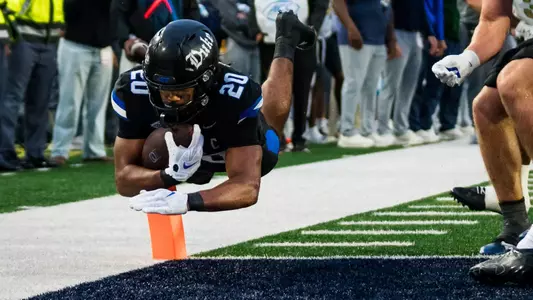
Duke’s winning touchdown at Virginia came from sophomore running back Nate Sheppard, who threw 28 yards to Brody Keefe in a 19-16 Friday night victory. The design mattered because it arrived after the Blue Devils had established Sheppard as a runner. Virginia reacted to the familiar action, and Duke used that reaction to create the cleanest passing window of the night.
The defense made one creative score sufficient. Duke held Virginia to three second-half points and recorded four sacks after halftime. Safety Patrick Smith-Young finished the result with an interception with 36 seconds left. The Blue Devils did not need the trick play to overcome a defensive collapse; they needed it to reward a defense that kept shortening the game.
The decision underneath it
That relationship should guide Duke at 5-2 and 2-2 in the ACC. Offensive creativity is most useful when it grows from a believable base. Sheppard’s pass worked because the defense had a reason to step toward him. Future counters can use the same principle—show the opponent a repeated picture, then change the eligible receiver or launch point at the decisive moment.
The defensive plan was less theatrical and more repeatable. Four second-half sacks suggest the coverage held long enough for pressure to finish. Duke should preserve that coordination against Boston College, whose run game produced 399 yards at Georgia Tech. The rush cannot chase the quarterback until the front first proves it can fit the designed run.
What carries forward
Smith-Young’s interception also shows the value of keeping the score compressed. Virginia’s final drive carried urgency, forcing a throw that the safety could attack. A defense that prevents early explosives creates those predictable late situations, where route depth and clock pressure become additional defenders.
Duke’s winning sequence joined imagination with discipline. The running back threw the touchdown; the defense protected it; the safety ended the last possession. None of those pieces must repeat in the same form. The standard is making each phase set up the next one, so the decisive call arrives as an extension of the game rather than a desperate exception.
Sources & reporting
This article adds independent analysis to publicly available reporting. We did not conduct the interviews or report the game firsthand. Report a factual error.