Miami can make Florida State defend two different speeds
A one-play touchdown and a long scoring march at Clemson showed the Hurricanes can change a game in very different ways.
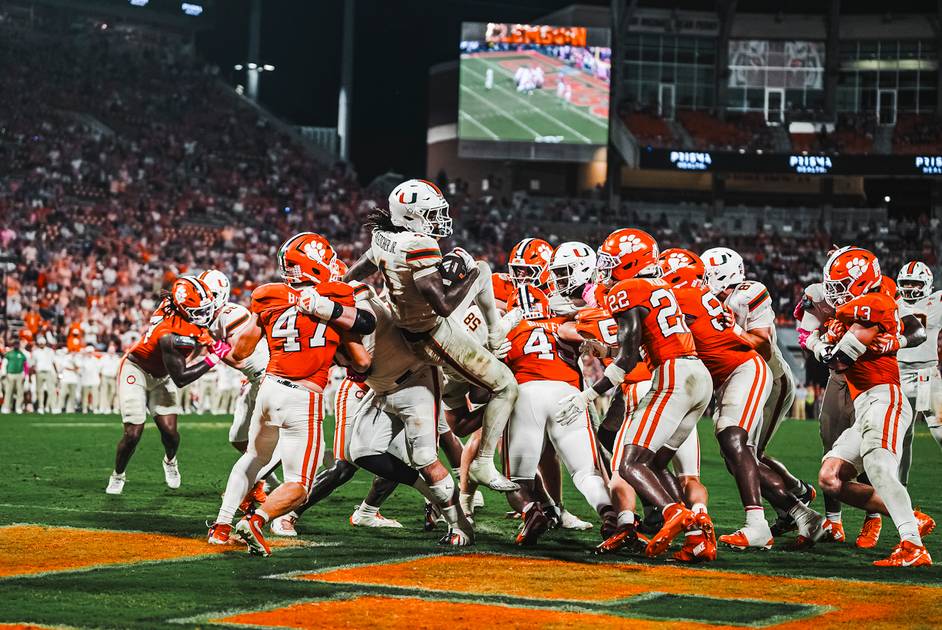
Miami hosts Florida State on October 17 after an open week, entering the matchup at 5–0 overall and 3–0 in ACC play. Its most recent game was a 41–13 win at Clemson on October 3. The official recap records a 61-yard touchdown pass to Cooper Barkate on Miami’s first offensive play and a third-quarter scoring drive covering 83 yards in 14 plays and 7:58.
Mark Fletcher Jr. scored twice on the ground, and Miami’s defense recorded six sacks. The official schedule confirms Saturday’s rivalry game at Hard Rock Stadium. The two very different touchdown drives offer a specific offensive strength to examine.
An explosive play changes the defense’s patience
An offense able to score quickly can make the opponent reluctant to leave any part of the field vulnerable. That caution can create space for shorter gains, but only if Miami remains willing to take them. Seeking another opening-play touchdown every series would discard some of the advantage created by the original one.
The long third-quarter drive at Clemson showed another way to exploit the defense. Repeated successful snaps require more players to execute more assignments, and the defense has to keep solving the same problem while the clock moves. Miami does not need to choose one speed as its identity. It should use the opponent’s response to determine whether the next best opportunity is an immediate attack or a sequence that gradually removes space and time.
Rivalry discipline protects that flexibility
Against Florida State, the value of this range is partly psychological but mostly practical. A defense cannot assume a short completion signals limited ambition, or that a running formation eliminates a passing threat. Keeping both possibilities credible gives Miami more room to recover when a first-down play fails. It also lets the offense change its approach without changing its entire personnel plan.
We would watch whether the Hurricanes can maintain that flexibility after the first dramatic event of the rivalry game. An early stop or a conceded score should not force every subsequent possession into one mode. Fletcher’s rushing presence and Barkate’s receiving production are established pieces of the latest win; using them together is the larger opportunity. Miami’s strongest performance would make Florida State defend the possibility of a quick strike while repeatedly proving that the Hurricanes can also finish a patient, demanding drive.
Sources & reporting
- Miami Athletics: Clemson recap, October 3 ↗
- Miami Athletics: 2026 schedule and October 17 Florida State game ↗
This article adds independent analysis to publicly available reporting. We did not conduct the interviews or report the game firsthand. Report a factual error.