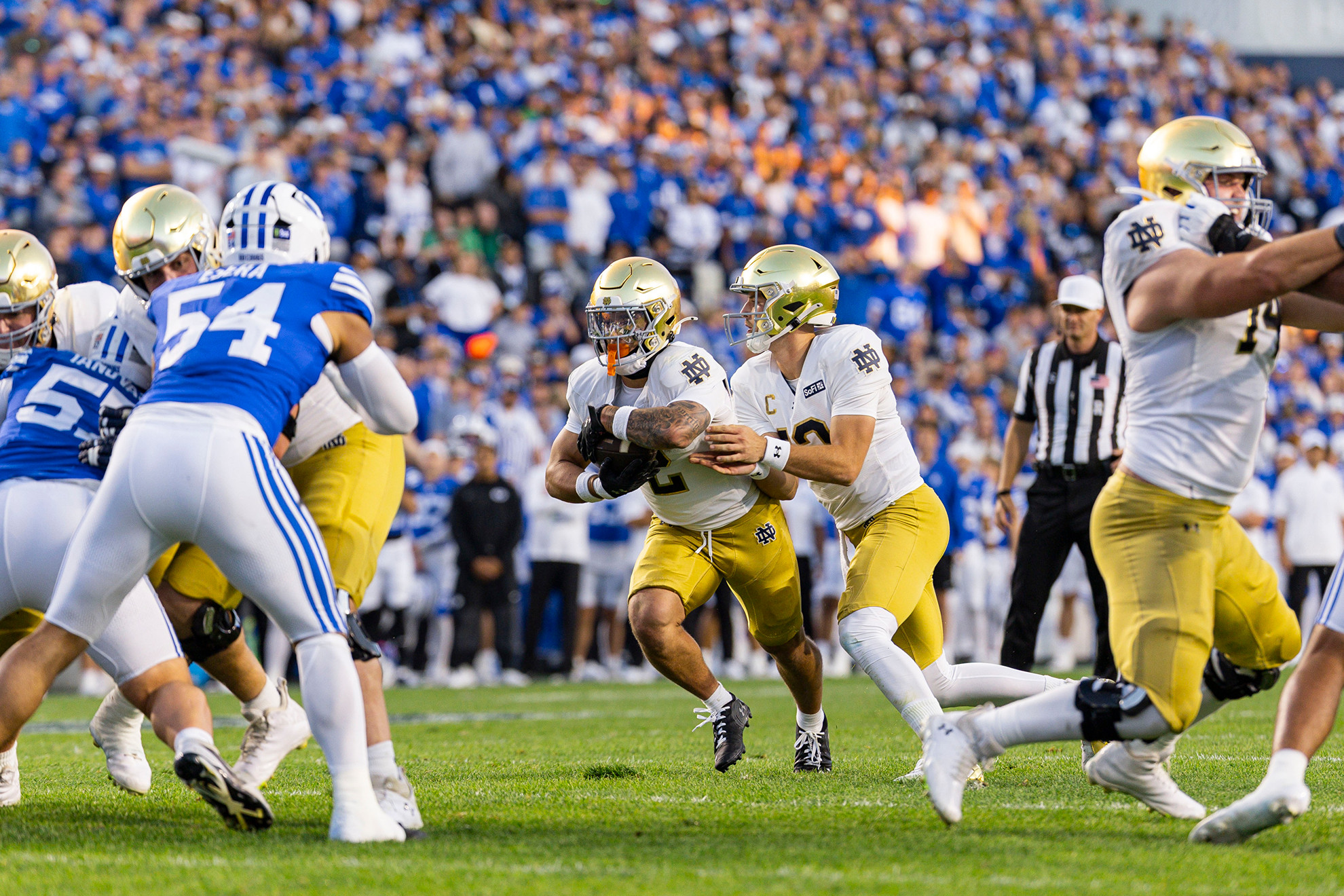
The opportunity arrived before the finish
Notre Dame received a short field after a muffed BYU punt and another after a failed fake. Those possessions ended with field goals from 31 and 39 yards. The Irish recovered from a 21–10 halftime deficit to lead 24–21 with 9:31 left, but ultimately lost 28–24 on October 17.
The special-teams opportunities mattered. They also illustrate why obtaining a favorable starting point and completing a possession are different parts of the game. Notre Dame still needed to execute the remaining distance, against a defense that could see exactly how little field remained behind it.
The clock and the ball are part of the assignment
Before halftime, an attempted CJ Carr spike at the BYU five was ruled a fumble on review. On the final possession, a fifteen-play Notre Dame drive ended without a scoring play. Neither sequence should be converted into guaranteed points in a hypothetical final score. The subsequent conference finding about the final clock ruling is explained in the dated correction below.
Carr completed 27 of 49 passes for 261 yards, and Jaden Greathouse caught eight for 125. Nolan James Jr. and Jonaz Walton supplied rushing touchdowns. There was enough offensive production to move the game back toward Notre Dame, but movement alone could not decide the remaining time or safely end an unfinished snap.
A comeback still requires its last possession
BYU’s winning drive covered 55 yards in ten plays and ended with 1:47 remaining. Notre Dame’s defense had allowed only seven second-half points; those seven were enough because the Cougars finished their final scoring opportunity.
The Irish are 6–1, with an instructive distinction to carry into their next preparation. Creating a route window and completing a pass are visible offensive skills. Handling the snap, knowing the clock situation and preserving the next down are equally real parts of the same scoring attempt. The correction is not a claim that one extra field goal would certainly have changed everything. It is making sure the next close-range opportunity is decided by the intended football play, rather than by losing the chance to run it.
October 19 correction and update
Follow-up reporting places the final snap at the BYU eight, not the seven as originally stated here. The Big 12 acknowledged that one second remained after the final incompletion and that replay incorrectly cleared the play. Notre Dame should have received another snap; the result of that unplayed opportunity cannot be assumed. Our new linked article examines the finding separately from the earlier offensive opportunities.
Sources & reporting
- Notre Dame Athletics: BYU postgame account, October 17 ↗
- The Salt Lake Tribune: BYU defeats Notre Dame ↗
- BYU Athletics: Notre Dame recap ↗
- Field Level Media: Big 12 acknowledges final-play clock error, October 18 ↗
- The Salt Lake Tribune / The Athletic: final-snap location and clock review ↗
This article adds independent analysis to publicly available reporting. We did not conduct the interviews or report the game firsthand. Report a factual error.